Basic & Reversed Flashcards
Purpose
Section titled “Purpose”Basic flashcards show a question first, then an answer. Reversed flashcards add a second flashcard automatically so you study both directions.
Combo cards can be used as an extension of basic cards, they are explained further below:
- Use Cross Combo when every combination produces a valid card.
- Use Sequential Combo when cross-pairings would be factually wrong.
Basic Format
Section titled “Basic Format”T | Title |Q | What is the capital of France? |A | Paris |I | Extra context |G | Geography |- Required fields:
QandA - Optional fields:
T,I,G
Modal Steps
Section titled “Modal Steps”- Right-click in a note.
- Choose Add flashcard -> Basic Card.
- Fill in fields and save.
Reverse Mode
Section titled “Reverse Mode”With reverse enabled, LearnKit creates:
- Question -> Answer
- Answer -> Question
Use the reverse option in the modal to enable this.
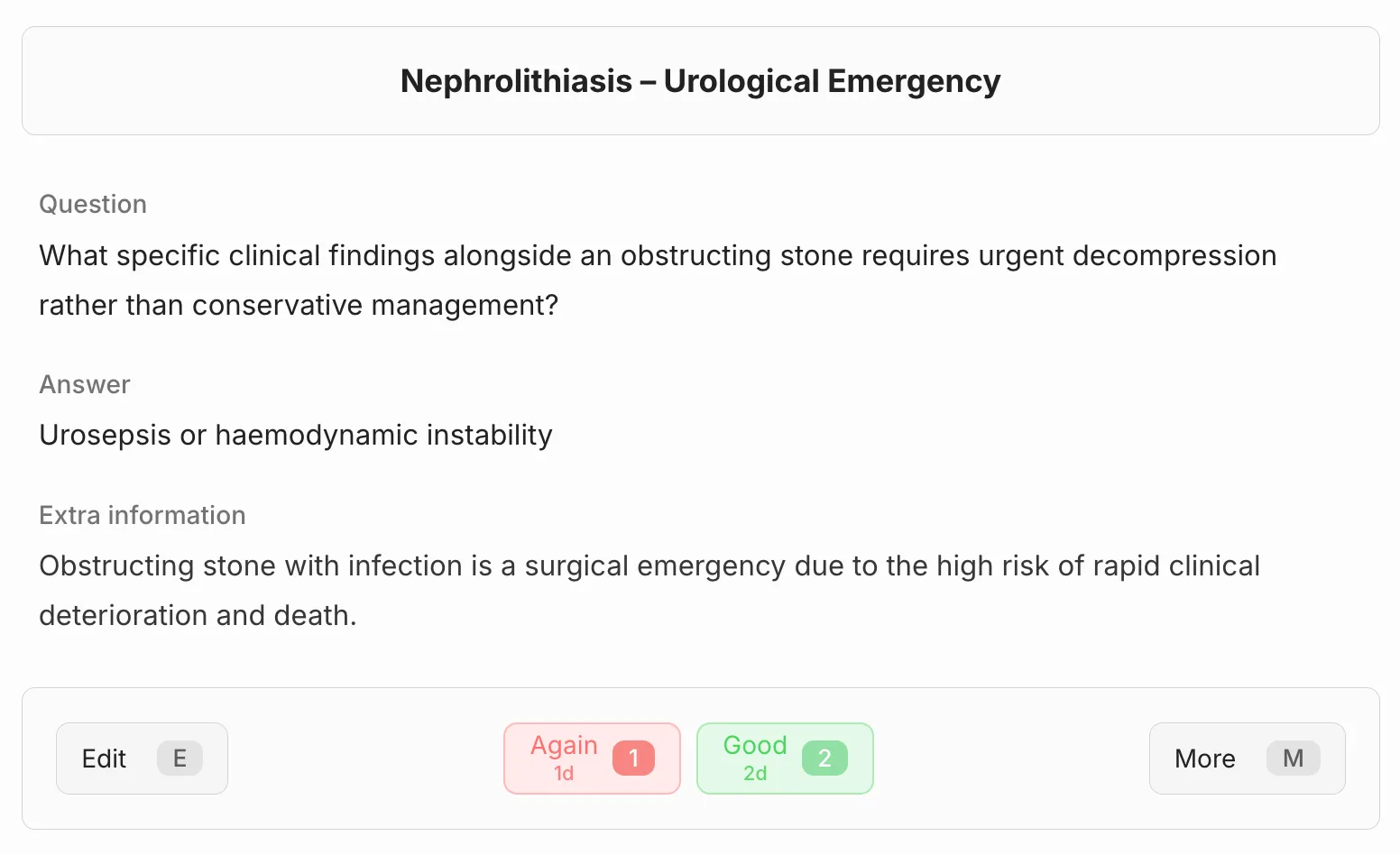
Basic card question and answer flow.
Grading
Section titled “Grading”After revealing the answer, grade your recall:
- two-button mode: Again / Good
- four-button mode: Again / Hard / Good / Easy
See Grading.
- If
QorAis missing, the flashcard cannot work correctly. - Keep one fact per flashcard for better retention.
- Use
Ifor hints or references instead of makingAtoo long. - Use groups to organise by topic.
Cross Combo Cards
Section titled “Cross Combo Cards”Cross Combo cards use :: (colon-colon) to separate multiple variants inside the Q and/or A fields. LearnKit generates the full Cartesian product — every possible combination of Q and A variants. Q count × A count = total cards.
This is useful when every combination produces a valid card. Common patterns:
- 1 × N: one question, multiple correct answers — test every facet.
- N × 1: multiple questions, all sharing the same answer.
- N × N: less likely to be used, multiple questions and answers that are interchangeable.
Credit: Combo card support was contributed by sevenRevy.
Example: One common question, many answers (1 × N)
Section titled “Example: One common question, many answers (1 × N)”T | Shock |Q | Define shock |A | Inadequate tissue perfusion to meet metabolic demands :: A state of circulatory failure resulting in cellular hypoxia :: MAP < 65 mmHg with evidence of end-organ hypoperfusion |1 Q × 3 A = 3 cards, all with the same question. Each card tests a different valid definition.
Example: Many questions, one common answer (N × 1)
Section titled “Example: Many questions, one common answer (N × 1)”T | Beta Blockers – Classes |Q | Atenolol :: Bisoprolol :: Metoprolol |A | Cardioselective beta blocker |3 Q × 1 A = 3 cards. Different drugs, same shared answer.
Cross Combo Tips
Section titled “Cross Combo Tips”- Keep variant lists short. A 4 × 4 cross combo generates 16 cards.
- Only one side needs variants — a single A paired with multiple Qs, or vice versa.
- Combine with Reverse Mode to study each combination in both directions.
- Use Cross Combo when every combination produces a valid card.
Sequential Combo Cards
Section titled “Sequential Combo Cards”Use ::: (colon-colon-colon) to separate variants. LearnKit pairs the i‑th Q variant with the i‑th A variant in strict one-to-one order. No cross-combinations are generated. Q and A must have the same number of variants, or LearnKit will flag a mismatch. This is a good way to create multiple flashcards in the same format without making multiple individual cards.
This is ideal for 1:1 paired lists where cross-pairings are incorrect.
T | Blood Cell Counts |Q | Anaemia ::: Polycythaemia |A | Abnormally low red cell count ::: Abnormally high red cell count |2 Q + 2 A = 2 cards:
| Card | Question | Answer |
|---|---|---|
| 1 | Anaemia | Abnormally low red cell count |
| 2 | Polycythaemia | Abnormally high red cell count |
2 variants = 2 cards, one per red cell disorder.
T | European Capitals |Q | France ::: Spain ::: Germany |A | Paris ::: Madrid ::: Berlin |3 variants = 3 cards, one per country.
Sequential Combo Tips
Section titled “Sequential Combo Tips”- Q and A must have the same number of
:::-separated variants. - Combine with Reverse Mode to study each pair in both directions.
- Use Sequential Combo when cross-pairings would be factually wrong.
Related
Section titled “Related”Last modified: 03/05/2026